
Checking Criminal History in Alexandria
Begin with the part of Alexandria criminal history that answers the question. The Virginia case-information hub routes a search to statewide OCIS, General District Court, participating Circuit Court, or appellate records. A known Alexandria misdemeanor or traffic charge belongs in General District Court. A felony may begin there as a preliminary matter and later move to Circuit Court. Current custody is different. The Sheriff confirms charge, bond, and court date by telephone because Alexandria has no official public online jail roster.
Use a full legal name, spelling variants, and a case number when one is known. Public court screens may not show a full birth date, so a name alone is weak identity proof. Older matters, sealed records, juvenile files, and cases outside a portal's coverage may be absent. The clerk's original file controls when a web result and a signed order differ.
- Define the record slice: police event, booking, court case, statewide CCRE history, or current custody.
- Search OCIS or the correct Alexandria court by name, case number, or hearing date.
- Call the Circuit Criminal Division or General District clerk when a case is missing or unclear.
- Ask APD or the Sheriff for the local record each office created.
- Use VSP SP-167 when an official Virginia criminal-history response is needed.
For a closer look at local report and arrest-check instructions, the APD Information Services page identifies the proper products.

The APD page helps separate a limited local record from a full police report or statewide CCRE check.
Alexandria Records Need City Boundaries
Alexandria does not belong to any county. Virginia treats it as an independent city and county-equivalent. That means City offices, Alexandria courts, APD, and the Alexandria Sheriff perform the local functions that a county government may perform elsewhere. Search forms may label the locality “Alexandria City.” Choosing Fairfax County because an address says Alexandria can send a criminal-record search to the wrong court or registry area.
Postal geography causes the trap. Many mailing addresses use “Alexandria” while the property lies in Fairfax County. Confirm the actual jurisdiction before requesting a police report, asking about a warrant, or filtering the registry. The Sheriff specifically warns that some Alexandria mailing addresses fall outside City limits. The street address, arresting agency, and issuing court usually show which records office has custody.
Boundary check: “Alexandria” in a mailing address does not prove the event occurred within the independent City of Alexandria.
Virginia Official Background Checks
The Virginia Department of State Police, Criminal Justice Information Services Division, maintains the Central Criminal Records Exchange. Its Virginia Criminal History Record Check uses SP-167 for the general name-based process. The online step generates a form. It does not return an instant public result. The subject's signature must be notarized, and the completed request is mailed with payment. Dissemination depends on Virginia law and the request type.
An SP-167 Virginia criminal-history check costs $15 under the official instructions reviewed for this build. A combined criminal-history and registry request costs $20. A sex-offender-only request is $15. Certain documented nonprofit products have separate rates. Remote notarization was offered for an added $15, but the current VSP page should control at the time of a request. APD's Alexandria-only arrest check is not a substitute.
| Official product | Published fee | Core limit |
|---|---|---|
| SP-167 Virginia criminal history | $15 | Name-based Virginia response; notarized consent and mail required |
| SP-167 history plus registry | $20 | Combines two Virginia products, not a national search |
| Sex-offender-only form | $15 | Registry product rather than a court-case file |
| FBI Identity History Summary | $18 FBI fee | Subject-only fingerprint-linked federal summary; collection costs vary |
The official VSP forms hub shows SP-167 and the restricted-purpose forms.
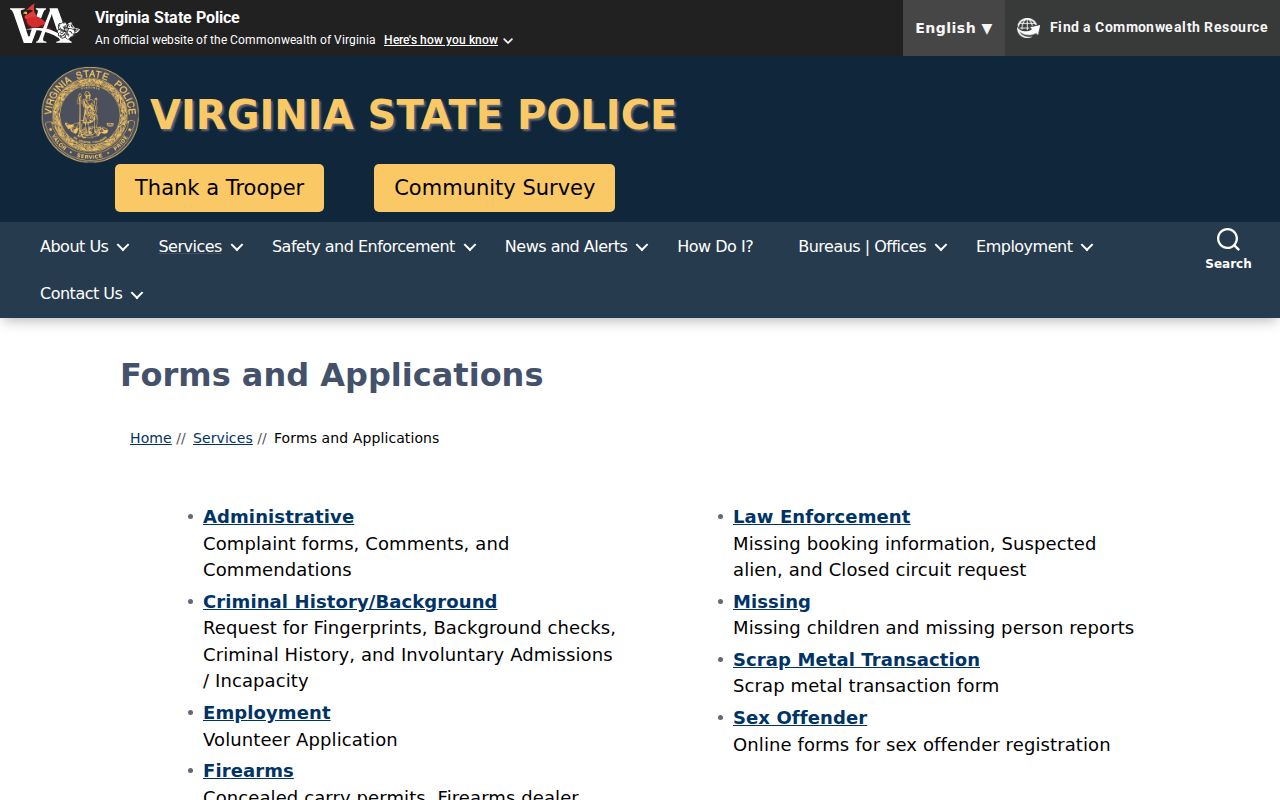
Choosing the right form matters because SP-230 and fingerprint-supported SP-325 checks are limited to authorized uses.
Alexandria Has No Public Rap Sheet
Alexandria does not publish an unrestricted name-search database of local rap sheets. Virginia Code §19.2-389 limits how criminal-history record information may be disseminated. The state route uses a formal VSP request, while APD offers a narrower local arrest check to a person who currently lives or works in the City. Court sites show cases, and the jail line shows custody facts. None is a complete substitute for the others.
The distinction guards against a common mistake. An arrest report states what police alleged or observed. A booking file records custody intake. The court clerk tracks filed and amended charges, hearings, and disposition. CCRE compiles qualifying identity-linked history under state rules. Comparing these records is often the only way to see why a booked charge differs from a final court result.
- Arrest report
- The originating agency's account of the alleged event and enforcement action.
- Booking record
- The Sheriff's intake and confinement file after a lawful commitment to custody.
- Court case file
- The clerk's record of filed charges, hearings, orders, disposition, and sentence.
- CCRE history
- Virginia's identity-linked repository compilation, released only through authorized channels.
The VSP background-check page sets out the official process.
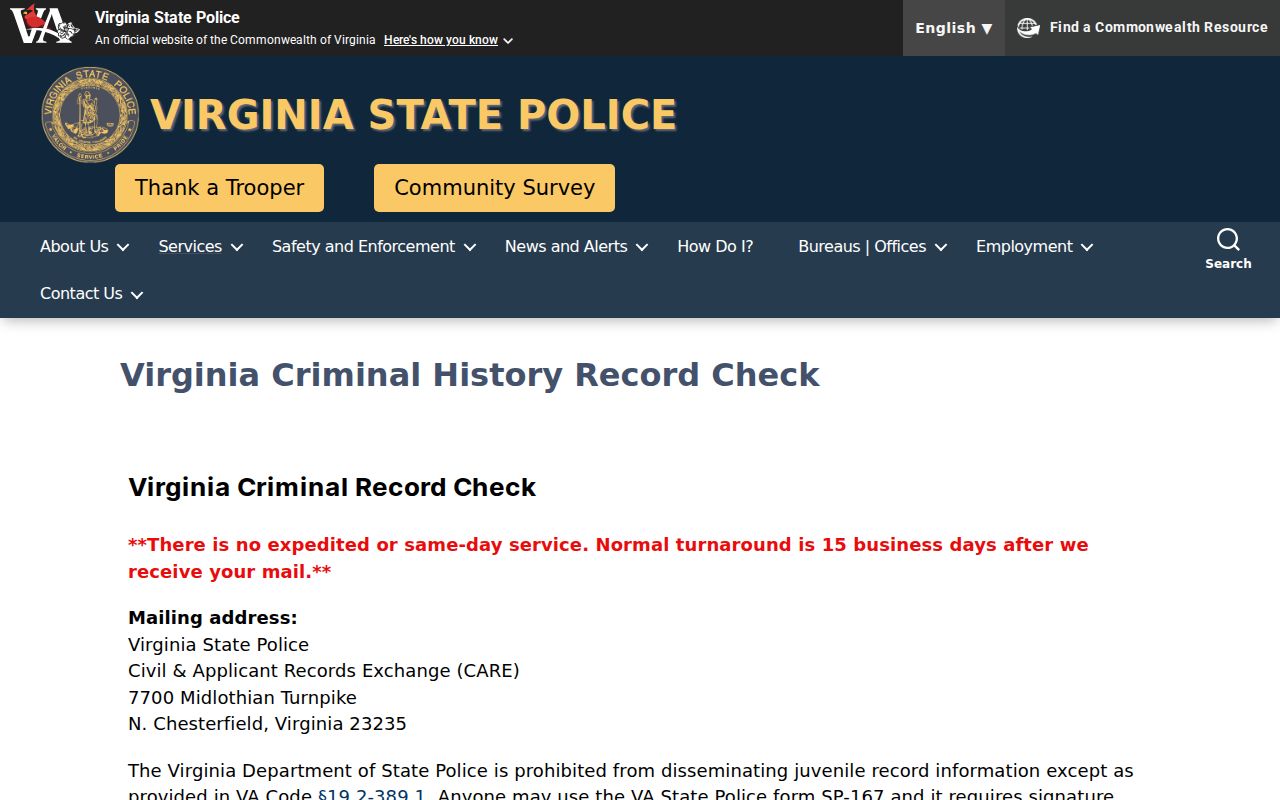
Its paper, notarization, and mailing steps show why the product should not be described as an instant people search.
Criminal Record Types
Alexandria criminal records are separate files with separate custodians. APD makes an incident or arrest report. The Sheriff creates a booking and confinement record after legal commitment. A magistrate may issue a warrant or summons and make an initial bail decision. General District Court keeps misdemeanors, traffic matters, and felony preliminary proceedings. Circuit Court keeps indicted felony cases and district-court appeals.
- Police report: the event narrative, alleged offense, evidence references, and report number held by APD.
- Booking record: the Sheriff's custody intake, booked charge, bond, court date, and later movement.
- Court case: the clerk's record of filed charges, hearings, pleas, orders, disposition, and sentence.
- CCRE history: the Virginia repository compilation governed by dissemination law.
- Custody or registry entry: a VADOC, federal, VINE, or registry record created for a distinct legal purpose.
A warrant search has no public Alexandria list. APD says a person may appear at headquarters to ask whether a warrant exists, but an active warrant can lead to arrest. Court docket events and the issuing clerk may help, yet sealed or new process may not appear online.
Alexandria Custody Records Split Three Ways
Local, state, and federal custody systems answer different questions. The William G. Truesdale Adult Detention Center holds local, state, and federal pretrial or sentenced prisoners under several legal authorities. Alexandria publishes no browser-based Sheriff roster. Call 703-746-5000 from 6 a.m. to 6 p.m. for charge, bond, and court date, or 703-746-5050 after hours. VINE adds release and transfer notices but may lag.
The Alexandria Sheriff's Office explains the detention and court-security roles.

That local source should come before state or federal locators for a recent Alexandria booking.
Use the VADOC Inmate Locator only after a person enters state correctional custody. The BOP locator is for sentenced federal prisoners and may not show a U.S. Marshals detainee temporarily held at Truesdale. The official BOP Inmate Locator illustrates the federal layer.

Custodian, not the building alone, determines which database can confirm the current status.
Inside an Alexandria Criminal Record
A CCRE response may connect identifiers, arrest cycles, fingerprints or transaction numbers, the arresting agency, charges, and reported dispositions. A public court screen can add case status, hearing information, charge text, code sections, disposition dates, fines, and costs. The Sheriff can confirm only a smaller set by telephone for a current detainee. Medical, security, juvenile, victim, and personal-identifier data are not routine public fields.
| Name and identifiers | Legal name, aliases, and matching details where the governing system permits display. |
|---|---|
| Arrest and booking | Agency, date, alleged charge, booking transaction, bond, court date, and custody movement. |
| Charges and statutes | Booked, filed, or amended offense text and Virginia code section, which may differ by stage. |
| Disposition | Guilty, dismissed, nolle prosequi, not guilty, deferred, certified, appealed, or another clerk-entered result. |
| Sentence | The court's signed judgment, punishment, costs, and supervision terms when public. |
| Custody or supervision | Local jail, VADOC, federal custody, probation, or release data held by the proper authority. |
“Nolle prosequi” means the prosecutor chose not to continue that charge at that time. “Certified to grand jury” means a felony matter moved forward from General District Court. Neither phrase means conviction.
Correcting Alexandria Criminal History Errors
A common name can point to the wrong person. First compare the court, locality, case number, charge date, and any public identifiers. Do not force a match when a full date of birth is hidden. If the event belongs to the right person but the outcome looks wrong, obtain the clerk's certified disposition. A signed final order carries more weight than a screenshot from a convenience portal.
For a CCRE error, list each questionable arrest cycle and compare it with the originating agency and court record. Submit the correction evidence through VSP or the originating agency's process. A dismissed charge may remain in an arrest or booking record unless Virginia law and a court order authorize expungement or sealing. Correction, expungement, and pardon are different remedies.
Public Access Laws in Virginia
The Virginia Freedom of Information Act applies to records held by City custodians, subject to exemptions and reasonable charges. It is not the path to Alexandria court files. The City itself directs court-record requests to the appropriate clerk. A clear VFOIA request names the department, event or booking number, date range, record type, and desired format. The City may produce, withhold with a legal basis, redact and partially produce, or invoke added time allowed by law.
Key Virginia laws:
Virginia Code §2.2-3700 et seq. sets the public-record framework for City agencies.
Virginia Code §19.2-389 limits dissemination of criminal-history record information.
Virginia Code §19.2-392.2 governs traditional petition expungement eligibility and procedure.
Virginia Code §9.1-913 controls public access to state registry information.
VFOIA does not compel release of sealed files, confidential juvenile records, private medical information, victim-sensitive details, or protected investigative and security material. Ask the custodian to segregate nonexempt parts and cite any exemption used.
Alexandria Records Span Two Centuries
Alexandria's justice record trail reflects its compact geography and long civic history. The Town Sergeant served as jailer beginning in 1780. Virginia replaced City Sergeant titles with Sheriff in 1971. The current courthouse opened at 520 King Street in 1981, and the direct-supervision detention center opened on Mill Road in 1987. The jail was later renamed for Deputy William G. Truesdale, who was killed in 1981 while transporting prisoners.
The Sheriff's official history preserves that local timeline.

The history explains why Alexandria criminal records may be held in modern digital systems, clerk files, agency archives, or older retained formats.
Sealed, Expunged, and Restricted Records
Traditional Virginia expungement under §19.2-392.2 is tied mainly to acquittals, nolle prosequi or dismissal, mistaken identity, and other specified circumstances. It is not a promise that any conviction can disappear. When venue lies in Alexandria, the petition goes to Circuit Court. The 2024 local civil fee schedule showed an $86 filing fee, but the clerk at 703-746-4044 should confirm the current amount and procedure.
After a valid expungement order, Virginia regulation directs VSP and known record holders to move the covered electronic and paper material into a separate sealed file. Newer Virginia sealing provisions have staged effective dates and distinct automatic and petition paths. Current law must be checked before relying on a category. Juvenile law-enforcement records also carry separate confidentiality protections. A search result that vanishes does not, by itself, explain which rule applied.
Alexandria Supervision Records Have Limits
Adult probation and parole supervision runs through VADOC Community Corrections District 36 at 4740 Eisenhower Avenue. The public starting point is the sentencing order, not a broad name-search database of probation case files. Search the court case, obtain the final order, and use the VADOC locator when the person appears in that system. District staff can explain their permissible verification process, while supervision records may remain restricted.
The official VADOC facilities and offices directory lists District 36.
Alexandria Recovery Court, pretrial services, and the Mental Health Initiative are separate local programs, not proof that a person is on ordinary probation or eligible for diversion.
Alexandria Criminal Records in Context
APD reported that overall crime fell 29.53 percent in 2025, with violent crime down 26.8 percent and property crime down 29.76 percent. Officers handled 67,274 calls and made 4,204 criminal arrests. Those are agency-reported workload and incident measures. They are not counts of convictions, and they do not show how many unique people appear in Alexandria criminal history.
Local court volume needs the same care. More than 48,000 proceedings occur at the Alexandria courthouse each year, while General District criminal dockets exceed 6,000 cases. A proceeding is not the same as a defendant or final judgment. One case can generate many hearings, and one arrest can produce several records. Use the figures to understand office workload, not to infer an individual's conduct.
Alexandria Criminal Records by City
Alexandria has no incorporated cities within it because the jurisdiction is itself an independent city. Neighborhoods and Fairfax County places should not be promoted as subordinate cities. The sole city record profile therefore focuses on APD Information Services, the three local trial courts, Truesdale booking, VFOIA, and the boundary issue that can redirect an apparently local search.
Alexandria Criminal Records
2025 estimate: 160,662 · APD, Alexandria courts, and Sheriff custody channels
The city profile keeps Alexandria police, court, and booking channels at local depth while routing statewide history to VSP.
Alexandria Criminal Record Offices
Route each Alexandria request to its true custodian. Police Information Services handles limited report products and the local arrest-check counter. The Sheriff maintains booking and confinement information. Court clerks maintain judicial case files. VSP maintains the state CCRE history. Sending a court request through City VFOIA or asking APD for a statewide rap sheet creates delay.
APD Information Services
3600 Wheeler Avenue
Alexandria, VA 22304
703-746-6200
Alexandria Sheriff
2003 Mill Road
Alexandria, VA 22314
703-746-4114
Circuit Criminal Division
520 King Street
Alexandria, VA 22314
703-746-4044
Truesdale Records
2001 Mill Road
Alexandria, VA 22314
703-746-5000
Note: Call first when access, current fees, copy certification, or a secure facility visit matters in Alexandria.